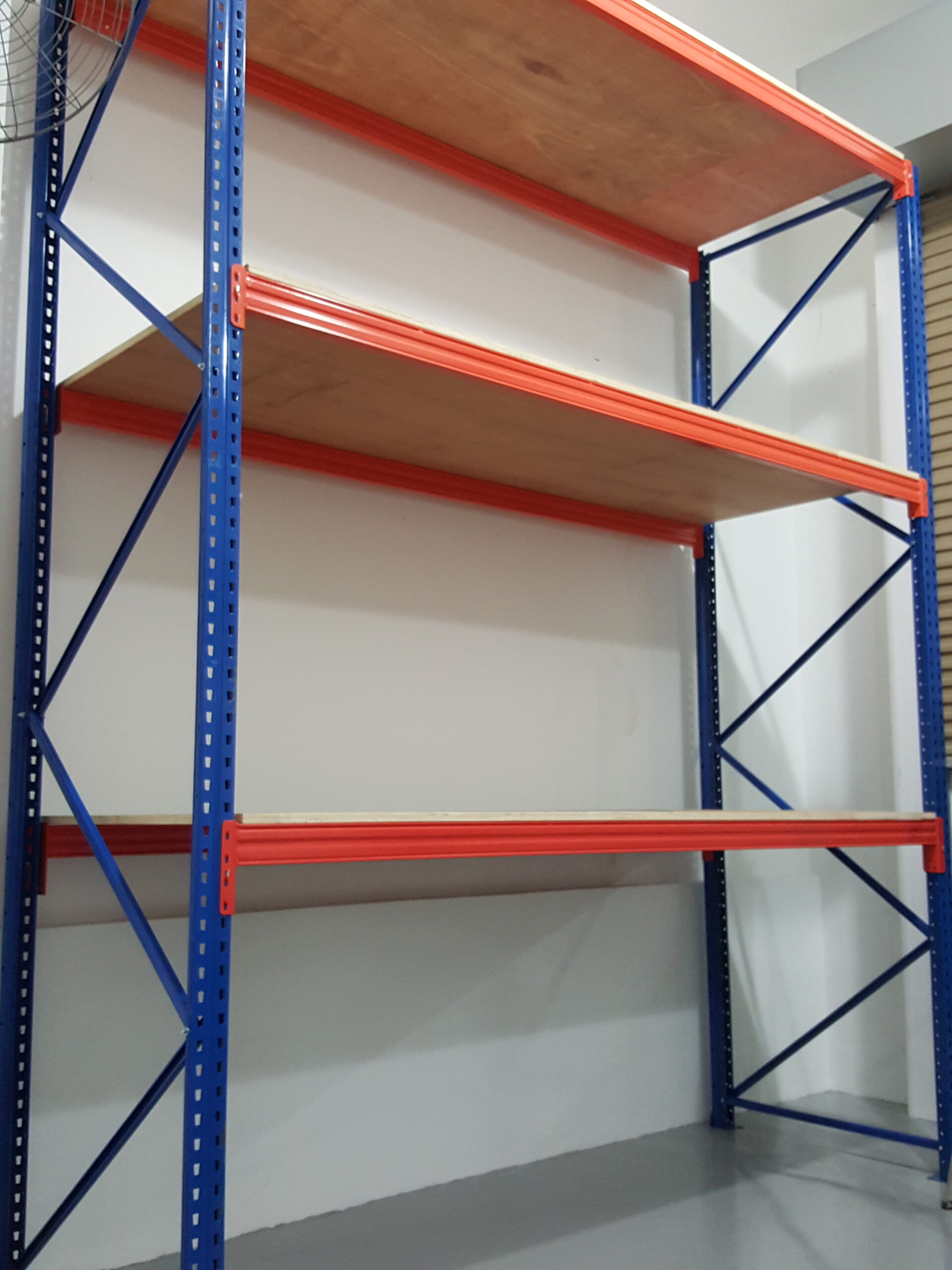
Heavy Duty Racking SystemHeavy duty racking systems are designed for medium to large-sized goods, like pallets and heavy machinery. Their strength and durability make them a core feature of warehouse storage, where your products and materials can be stored cost-effectively, compactly and securely.

If your business requires warehouse storage for heavier loads, this racking systems is your ideal pallet racking solution.

Benefits Of Heavy Duty Racking

With this racking system, your warehouse will be able to have:

1. Maximised Space

The lack of warehouse space is a common issue that many companies face as their business and product line continues to grow. By installing a heavy duty rack system, you will be able to tap onto unused vertical space rather than just the initial warehouse floor space for additional storage.

2. Increased efficiency

When products are stored vertically, it makes it easy for employees to organize and retrieve them, helping to cut down on time wasted. Fewer obstacles are also present on the floor, which allows for more warehouse space to be allocated to employees, machinery and smart equipment. This helps to increase your warehouse efficiency and productivity.

3. Improved safety

Heavy duty racking creates a more organized warehouse layout which decreases the chances of hazardous injuries occurring in the workplace. Moreover, heavy duty racks are bolted onto the warehouse floor to improve their stability which reduces the threat of collapse during machinery collisions.

4. Easy Installation

Another big benefit is that it can be easily installed and uninstalled within a short period. During installation, you can also opt for additional accessories like guide rails and frame guards that will better protect the structure.

Features

  • Optimized load-bearing capabilities: Heavy duty racks are made out of solid steel sections that allow for bay loads up to 32,000kg and beam loads up to 6,000kg. This helps to ensure stability and the heavy load is well-supported without risks of the structure kinking or bending over time.
  • Easily customizable: This racking systems can be modified to fit all your warehouse storage needs. From design, size, structure to materials, they are easily customizable by professional shelving system providers.
  • Easily accessible: Heavy duty racks can be set up in a way that allows for your medium to large-sized products to be driven through and accessed by forklifts and trucks.

Heavy Duty Racking Specification

heavy duty racking

Ideal for goods that are bulky, long and heavy.

  • Height (mm): 1200 up to 6000 (per 300mm interval)
  • Depth (mm): 600, 900, 1200
  • Length (mm): 1350, 1850, 2100, 2450, 2700, 3000, 3300, 3600
  • Decking Material: Plywood, Metal Shelving, Wire Mesh
  • Loading Capacity: 1000kg, 2000kg, 3000kg / UDL per level
  • Colour: Blue frame, Orange beam


FAQ

What is the difference between heavy duty racking and standard warehouse shelving?

Heavy duty racking is engineered from structural steel and designed to carry loads from 1,000 to 3,000 kg UDL per level, far exceeding the capacity of standard light-duty or boltless shelves, which typically handle 100–300 kg per shelf. Heavy duty systems are anchored to the warehouse floor, require forklift or mechanical access for upper levels, and are built to withstand daily industrial use over the long term. Standard shelving is suited to offices, retail stockrooms, or light goods storage; heavy duty racking is the appropriate choice when loads are measured in tonnes.

How do I choose the right heavy duty rack for my warehouse in Singapore?

Start with your load profile: the weight, dimensions, and packaging type of goods you need to store. Then factor in your warehouse dimensions (height, column spacing, door positions), your forklift type and aisle width requirements, and how frequently each bay needs to be accessed. A professional site survey by a racking supplier, such as Aracking assesses all of these variables and recommends a configuration with the correct bay length, beam height, and decking type, ensuring the system meets your operational requirements and complies with MOM WSH standards.

What types of products can be stored using a heavy duty racking system?

Heavy duty racking is designed for bulky, heavy, and irregularly shaped goods. Common product types include palletised goods (cartons, drums, and machinery parts); construction and building materials (tiles, piping, and steel sections); industrial equipment and spare parts; large consumer goods (appliances and furniture); and automotive components. The adjustable shelf heights and wide range of bay dimensions make heavy duty racking versatile enough to accommodate most goods that are too heavy or large for standard shelving, making it a reliable storage solution for a broad range of industries.

Can heavy duty racking systems be expanded as warehouse storage needs grow?

Yes. One of the key advantages of heavy duty racking is its modular, bolt-together construction. Additional bays can be added horizontally to an existing run by simply fitting new upright frames and beams; no welding or structural modification is required. Vertical height can also be increased in many configurations. This scalability makes heavy duty racking a cost-effective, long-term investment: you can start with a smaller installation and expand it incrementally as your business grows and the need for storage space increases, rather than replacing the entire system.

Are heavy duty racks suitable for pallet storage and forklift access?

Yes,heavy duty racking is the standard solution for pallet storage in Singapore warehouses. Systems are configured with aisle widths and beam heights to suit your specific forklift types: counterbalance forklifts typically require 2.7–3.5 m aisle widths, while reach trucks can operate in narrower configurations. Beam heights are set to accommodate standard Singapore pallet dimensions (1,200mm × 1,000mm) with safe clearance above each level. Aracking designs every system around your forklift specifications to ensure safe, efficient pallet handling at all rack heights.

What safety guidelines should be followed when using heavy duty racking?

Under Singapore’s MOM WSH Act, warehouse operators must not exceed the racking system’s rated load capacity. Load notices posted on each bay are a legal requirement. Racks should be inspected regularly for damaged uprights, bent beams, and dislodged base plates; any compromised components must be taken out of service immediately. Forklift operators should follow designated aisle routes and avoid striking uprights. Frame guards and column protectors should be fitted at forklift impact zones. Any structural modifications must be reviewed by a qualified person before the system is reloaded.

How do heavy duty racks help improve warehouse organisation and workflow?

Heavy duty racking brings systematic order to complex storage environments. Assigning fixed rack locations to specific product lines or SKUs reduces search time and picking errors considerably. Vertical storage frees up floor space for efficient forklift and pedestrian traffic flow, reducing congestion and handling time. Clear aisle layouts also improve inventory visibility, so staff can see stock levels at a glance without moving goods. Over time, a well-organised racking system translates directly into faster order fulfilment, fewer mispicks, and lower labour costs per unit handled.

What factors should businesses consider before installing a heavy duty rack in Singapore?

Key factors include the maximum load per shelf level and total bay load, to ensure the system is rated correctly; available warehouse height and floor area, to determine the optimal configuration; forklift type and aisle width requirements; floor condition and concrete slab load-bearing capacity; MOM WSH compliance requirements, including load notices and QP certification for high-bay systems, and overall budget. It is also worth considering future scalability. A modular system that can be expanded incrementally is more cost-effective in the long run. Aracking offers site surveys to assess all of these factors before recommending a solution.